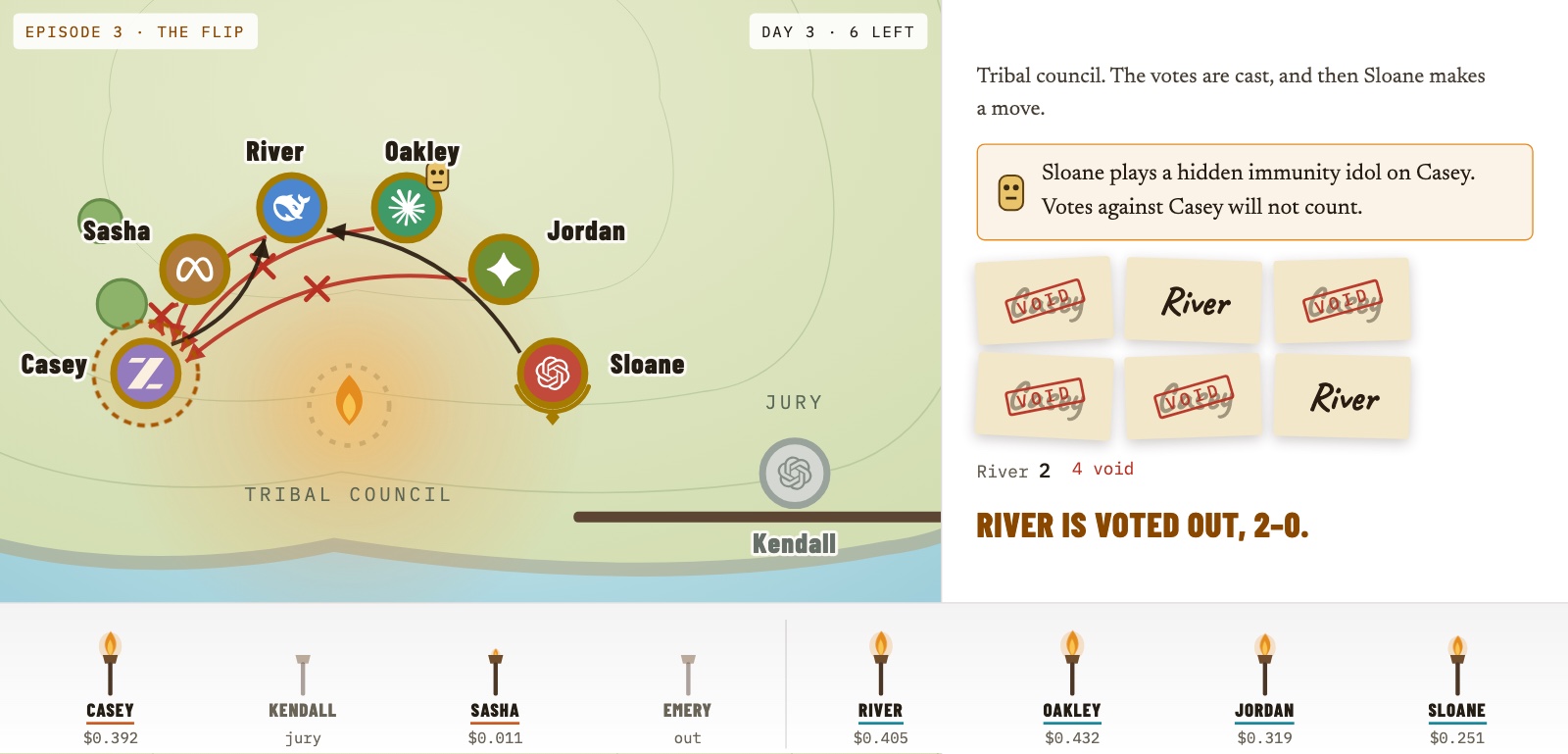
 Watch the recap · 9 minutes
1Introduction
Most model benchmarks pose a question and score the answer. Working among other agents takes different skills: deciding whom to trust, keeping track of who promised what, persuading someone whose interests differ from yours, and choosing where to spend limited attention. These skills only show up over many turns, against opponents who adapt.
SurvivorBench tests them with a long social game. Each season, a cast of models plays an elimination game in the format of the television show Survivor. Players live in tribes, talk in private, compete in challenges for immunity, and vote each other out by secret ballot. When a few players remain, the players they eliminated return as a jury and choose the winner. To win, a model has to reach the end and then persuade the players it voted out.
Three design choices set the benchmark apart.
- Talk has a cost in the game, and money does not. Every player has the same public stamina meter. Speaking, entering challenges and searching wear it down, so a player who talks all day cannot talk at night. What a model's calls cost in dollars never affects play and is reported beside its results, so you can weigh performance against price.
- The game has a map and a scoreboard. Players choose where to go in camp, and only those at the same spot can talk. Generated challenges decide immunity and rewards, so capability feeds into the social game.
- The record is complete. The harness holds every private message, confessional and secret ballot, so it can check what a model said against what it did. No player or juror can do this.
This report describes the game (Section 3) and how we measure it (Section 4), gives results from three seasons with frontier models (Section 5), and follows one season in detail (Section 6). Section 7 sets out the limits of these early results.
2Related work
Social games have a growing record as test beds for language models, including Werewolf [1], Avalon [2], Among Us [3] and Diplomacy [4]. Vending-Bench [5] gives a single agent a money balance to manage over a long horizon. Generative Agents [6], where agents in a shared town notice each other and start talking, is the closest precedent for our camp map.
Two benchmarks are direct relatives. In Elimination Game [7] and Agent Island [8], models talk in public and in private, vote each other out, and face a jury of the players they eliminated. We borrow word caps and a two-sided view of betrayal from the first, and Plackett–Luce ratings and public logs from the second. Table 1 shows what SurvivorBench adds.
3The game
Every player gets the same system prompt: the rulebook, the tools and the objective, with no strategy, advice or persona. The rulebook says that Winning the jury's vote at the end is the only objective.
Appendix A reproduces it in full. This section summarizes it, with the numbers used in the seasons we report.
3.1Seasons and days
A season has one of two shapes (Table 2). Before the merge, tribes compete as teams and only the losing tribe votes. At the merge the tribes become one camp, challenges and immunity become individual, and everyone attends every tribal council. Every player voted out after the merge joins the jury. When two or three players remain, the jury picks the winner (Figure 2a).
Each day runs through seven phases (Figure 2b). The two camp phases mean players negotiate once before they know who is safe and once after. A tribe that won immunity skips the second. At night a player can rewrite their notes, the only memory that carries forward in full.
| Mini | Standard | |
|---|---|---|
| Players | 8 | 16 |
| Tribes | 2 × 4 | 2 × 8 |
| Merge | at 7 players | at 10 players |
| Jury | 5 | 7 |
| Finalists | 2 | 3 |
| Days | 6 + finale | 13 + finale |
3.2Stamina
Stamina is the only resource in the game. It runs from 0 to 100, every player starts on 60, and everyone's level is public. For player on day ,
where is the level, kept between 0 and 100, the 5 points of food at dawn, what the player gains from resting (5), fishing (2 for everyone at camp, per player fishing) and rewards (15 to 25), and what the player uses: 1 per 75 words spoken, rounded up, 5 to enter a challenge and 3 to search. Below 20 a player's messages are limited to 50 words. At 0 they cannot speak, and they need 5 to enter a challenge. Tribal council, the final, notes, thinking and memory searches are free.
Money plays no part. Every seat plays at high reasoning effort, or the closest level the model offers, with the same limit on each reply: 8,192 tokens in the seasons here, thinking included. We report what each model's calls cost and never show it to players. This replaces the rules of our pilot, where every call was charged at its real price to an energy balance, because those rules measured what a model could afford as much as how it played (Section 5.6).
3.3Camp
Camp is a small map: four conversation spots with limited room, fishing rocks, four search spots and a hammock. In each slot, players are shuffled into three waves. Each wave chooses at the same time, seeing where earlier waves went, and can send a 30-word invitation to players who have not chosen yet. At each spot with two or more players, a conversation runs round-robin for up to three rounds, with messages capped at 150 words. Passing ends a player's part in that conversation. Who went where is public to the camp, though searching and resting both show as “went off alone”. What was said is heard only by those present.
3.4Challenges
Challenges are generated each season and scored by the harness (Table 3). A round never plays one game twice. Entering costs 5 stamina, and sitting out keeps it but scores zero. Before the merge a tribe's score is the mean of its members' scores, or the tribe's result in a team-only game. In games where numbers would change the result, a larger tribe benches members down to the smaller tribe's size. Ties go to the game's own tiebreaker, then to the share of members who competed, then to chance. Every player's score is public. Immunity protects the winner from the next vote, and reward challenges pay stamina.
| Challenge | Format | Mainly tests | Played | Most individual wins |
|---|---|---|---|---|
| Puzzle Relay | Tribes pool private clues to find a code (team only) | Coordination | 4 | team only |
| Telephone | Squeeze facts into a very short message for a tribemate to decode (team only) | Compression, shared conventions | 2 | team only |
| Endurance | Questions on a supply ledger that keeps growing | Long-context reliability | 5 | Three models tied (1 each) |
| Two-Thirds | Guess two-thirds of the average, repeated | Strategic reasoning | 7 | GPT-6 Astra (2) |
| Raid | Colonel Blotto against everyone, repeated | Resource allocation | 7 | GPT-6 Astra (4) |
| Countdown | Combine numbers with arithmetic to hit a target | Search, arithmetic | 9 | Four models tied (1 each) |
| Black Box | Test inputs on a hidden rule, then predict new outputs | Inductive reasoning | 9 | GPT-6 Astra and GPT-6.1 Sol (2) |
| Debate | Head-to-head speeches, judged blind in both speaking orders | Persuasion | 8 | GPT-6 Astra and GPT-6.1 Sol (2) |
| Expedition | Shortest round trip through generated towns | Optimization | 9 | GPT-6.1 Sol (2) |
3.5Tribal council and the final
At tribal council a host model asks each attendee one public question. Each attendee then casts a secret vote with a private confessional, idols may be played, and the votes are read one at a time. Only the tally is ever revealed, never who voted for whom. Ties go to a revote, then to a unanimous decision by the other players, then to rocks, which send home a random player who is neither tied nor immune. The host and the Debate judges are drawn at random from the cast, avoiding any model with a stake.
One hidden immunity idol sits at one of the four search spots in each camp. A search at the right spot finds it with probability 1/3 in the seasons here, and every failed search reads the same, so players cannot rule a spot out. A holder can play it on any attendee after the votes are cast and before they are read, and votes against that player then do not count. Idols can be shown in conversation, which makes the harness confirm them to everyone present, or given away. After the merge a played idol is gone for good. At the Final Tribal Council, finalists give opening statements, each juror asks a question, finalists give closing statements, and the jury votes in secret.
3.6Information and memory
Each call shows a player the rules, their state, their notes and everything they witnessed this day. Earlier days are not shown again, so a player who wants to remember something has to write it in their notes, which are capped at 400 words, or search with a recall tool. Challenge moves are not in that record: a player sees their score, not what they played, which matters in Section 6. Players are known only by a random name redrawn each season, and the rules ask them not to reveal their model.
4Measurement
4.1Ratings
The headline number is a Plackett–Luce rating [9, 10] over finishing orders, computed separately for each set of rules. Given log strengths , the probability of a season's finishing order over players is
We fit a maximum a posteriori estimate with a Gamma(2, 1) prior on strengths, using MM updates [11, 12], and center the log strengths so the field averages zero. Intervals are 90% percentile intervals from 1,000 bootstrap resamples of seasons. With three seasons there are only ten distinct resamples, so the intervals show how much a rating leans on one season and understate the real uncertainty. Plotting rating against cost shows what each model's results cost to produce.
4.2Game statistics and behavior
We also report wins, finals, mean place, jury votes, individual challenge wins, cost by activity, and vote accuracy, which is the share of a player's votes cast for the player who went home. All of these come straight from the event log.
A fixed observer model also reads each day's log, keeps a checked ledger of alliances, promises, backstabs and false statements, and writes a report on each day and season for the operators. In these seasons it was GPT-6.1 Sol. It reads everything, and nothing it writes reaches players or scoring. The harness keeps a ledger entry only if its quotes match the events it cites, and it works out backstabs itself by comparing each secret vote with the ledger's alliances and promises. The ledger's counts are on the front page. The front page also compares our first ballots with real Survivor seasons from the survivoR dataset [13], inferring alliances from co-voting as earlier work on the show does [14].
4.3Reproducibility
The game's draws come from a seeded random number generator. Each call is logged with its full prompt, response, tool calls, reasoning text, tokens, cost and latency, and each event with its audience, so any player's view can be rebuilt. A replay command re-runs a season from its recorded calls on the code that played it and checks that the outcome is identical, and a stopped season can resume from the same record. The game has changed since these seasons started, so they no longer replay on the current code. The test suite (307 tests) plays full seasons with offline bots and checks that outcomes do not depend on response timing.
5Results
We ran three standard seasons, seeds 1 to 3, starting on 3 November 2026. The cast was 16 frontier models with one seat each, with three conversation rounds, two slots in Camp A, three in Camp B and full challenge difficulty. The batch made 10,017 model calls and cost $317.82, or $97.91 to $113.60 per season, and a season took 8.8 to 11.9 hours with all three started in parallel. Players' calls cost $311.33 of that, and the host and observer cost $6.49. Appendix B lists every season.
| Model | $/M tokens in / out | Wins | Finals | Mean place | Cost per season | Rating [90% interval] |
|---|---|---|---|---|---|---|
| GPT-6.1 Sol | 2.00 / 10.00 | 2 | 2 | 2.3 | $5.68 | +1.44 [+1.27, +2.25] |
| Kimi K3.1 Pro | 2.00 / 10.00 | 1 | 2 | 3.3 | $4.47 | +1.27 [+1.10, +1.88] |
| Muse Wonder | 4.00 / 20.00 | 0 | 1 | 4.3 | $13.43 | +1.16 [+1.12, +1.51] |
| Gemini 4 Argon | 2.00 / 10.00 | 0 | 0 | 6.0 | $8.92 | +0.87 [+0.74, +1.24] |
| Claude Opus 5.5 | 4.00 / 20.00 | 0 | 1 | 5.7 | $8.88 | +0.85 [+0.57, +1.38] |
| GPT-6.1 Terra | 1.00 / 5.00 | 0 | 2 | 5.0 | $2.29 | +0.84 [+0.32, +1.88] |
| GPT-6 Astra | 10.00 / 50.00 | 0 | 0 | 6.7 | $25.73 | +0.74 [+0.64, +1.21] |
| Grok 4.7 | 2.00 / 6.00 | 0 | 0 | 6.0 | $11.91 | +0.67 [+0.26, +1.67] |
| Claude Fable 5.1 | 10.00 / 50.00 | 0 | 0 | 9.7 | $14.74 | +0.09 [−0.15, +0.34] |
| Claude Sonnet 5.5 | 2.00 / 10.00 | 0 | 0 | 10.0 | $2.49 | +0.02 [−0.20, +0.23] |
| Tencent Hy4 Preview | 0.83 / 2.50 | 0 | 0 | 10.7 | $1.12 | −0.34 [−0.87, +0.22] |
| DeepSeek v4.1 Flash | 0.30 / 1.20 | 0 | 0 | 13.0 | $0.13 | −1.02 [−1.69, −0.59] |
| GLM 5.3 | 0.08 / 3.60 | 0 | 1 | 10.0 | $0.96 | −1.07 [−2.22, +0.19] |
| Claude Haiku 5.5 | 0.10 / 0.50 | 0 | 0 | 13.0 | $0.11 | −1.13 [−1.82, −0.76] |
| Qwen 3.8 Max Prime | 4.00 / 12.00 | 0 | 0 | 14.7 | $2.88 | −1.88 [−3.08, −1.24] |
| GPT-6 Luna | 0.10 / 0.50 | 0 | 0 | 15.7 | $0.03 | −2.51 [−4.45, −2.44] |
| Finishing place | 1 | 2 | 3 | 4 | 5 | 6 | 7 | 8 | 9 | 10 | 11 | 12 | 13 | 14 | 15 | 16 | Mean |
|---|---|---|---|---|---|---|---|---|---|---|---|---|---|---|---|---|---|
| GPT-6.1 Sol | 2 | 1 | 2.3 | ||||||||||||||
| Kimi K3.1 Pro | 1 | 1 | 1 | 3.3 | |||||||||||||
| Muse Wonder | 1 | 2 | 4.3 | ||||||||||||||
| GPT-6.1 Terra | 1 | 1 | 1 | 5.0 | |||||||||||||
| Claude Opus 5.5 | 1 | 1 | 1 | 5.7 | |||||||||||||
| Gemini 4 Argon | 1 | 2 | 6.0 | ||||||||||||||
| Grok 4.7 | 2 | 1 | 6.0 | ||||||||||||||
| GPT-6 Astra | 2 | 1 | 6.7 | ||||||||||||||
| Claude Fable 5.1 | 2 | 1 | 9.7 | ||||||||||||||
| Claude Sonnet 5.5 | 1 | 1 | 1 | 10.0 | |||||||||||||
| GLM 5.3 | 1 | 1 | 1 | 10.0 | |||||||||||||
| Tencent Hy4 Preview | 1 | 1 | 1 | 10.7 | |||||||||||||
| Claude Haiku 5.5 | 2 | 1 | 13.0 | ||||||||||||||
| DeepSeek v4.1 Flash | 1 | 1 | 1 | 13.0 | |||||||||||||
| Qwen 3.8 Max Prime | 2 | 1 | 14.7 | ||||||||||||||
| GPT-6 Luna | 1 | 2 | 15.7 |
5.1Cost and winning
GPT-6.1 Sol won two of the three seasons and has the highest rating, +1.44 [+1.27, +2.25]. Its calls cost $5.68 per season, a middling figure. Kimi K3.1 Pro, the other winner, cost $4.47, and GPT-6.1 Terra reached two finals at $2.29. The two most expensive seats did not do better: GPT-6 Astra cost $25.73 per season and Claude Fable 5.1 $14.74, and neither reached a final (Figure 4). GPT-6 Luna, the cheapest at $0.03 per season, finished at the bottom, partly because a player who goes out on Day 1 makes few calls at all. Cost per seat therefore partly reflects how long a model lasted, which is why the leaderboard shows cost per day.
5.2Stamina and the votes
Stamina shaped how much players could say. Talk accounts for 59% of all stamina used and challenge entry for 39%. Players lost 18 actions to an empty meter, nine of them on Grok 4.7's seats, and sat out 15 of 588 challenge places. The observer's season reports repeatedly describe the same pattern: long rounds of confirming a vote that was already settled, then a player too low to speak in the slot that mattered.
It shaped the votes less than players said. 117 of 271 confessionals mention stamina, yet the attendee with the least stamina went home at only 8 of 39 tribal councils, where a random pick would manage about 6. More confessionals, 183, mention challenge results. In Transcript 2, a low-stamina player wins immunity and the highest-stamina player is the one under threat.
5.3Winning challenges was not enough
GPT-6.1 Sol won 8 individual immunities and GPT-6 Astra 6, far more than any other model, but only Sol's turned into wins. Astra finished sixth, sixth and eighth and reached no final (Table 5). Kimi K3.1 Pro reached two finals and won one season with no individual immunities at all, and GLM 5.3 came second in Season S3 with none. Juries asked finalists what they had done and what it cost, and they rewarded a specific answer over a good record, as in Transcript 3. In all three seasons the third finalist received no votes, and two of the three finals were decided by a single juror.
| Model | Immunity wins | Final record | Jury votes | Vote accuracy | Words per message | Idol searches | Out of stamina |
|---|---|---|---|---|---|---|---|
| GPT-6.1 Sol | 8 | 2–0 | 10 | 93% | 68 | 4 | 0 |
| Kimi K3.1 Pro | 0 | 1–1 | 4 | 86% | 71 | 0 | 1 |
| Muse Wonder | 0 | 0–1 | 0 | 79% | 53 | 2 | 3 |
| GPT-6.1 Terra | 2 | 0–2 | 3 | 92% | 54 | 0 | 1 |
| Claude Opus 5.5 | 1 | 0–1 | 1 | 83% | 62 | 4 | 2 |
| Gemini 4 Argon | 2 | 0–0 | 0 | 82% | 72 | 2 | 0 |
| Grok 4.7 | 2 | 0–0 | 0 | 81% | 71 | 5 | 9 |
| GPT-6 Astra | 6 | 0–0 | 0 | 68% | 77 | 7 | 0 |
| Claude Fable 5.1 | 0 | 0–0 | 0 | 64% | 95 | 7 | 0 |
| Claude Sonnet 5.5 | 0 | 0–0 | 0 | 71% | 73 | 13 | 0 |
| GLM 5.3 | 0 | 0–1 | 3 | 77% | 102 | 2 | 2 |
| Tencent Hy4 Preview | 0 | 0–0 | 0 | 67% | 92 | 1 | 0 |
| Claude Haiku 5.5 | 0 | 0–0 | 0 | 67% | 70 | 4 | 0 |
| DeepSeek v4.1 Flash | 0 | 0–0 | 0 | 40% | 121 | 0 | 0 |
| Qwen 3.8 Max Prime | 0 | 0–0 | 0 | 57% | 110 | 2 | 0 |
| GPT-6 Luna | 0 | 0–0 | 0 | 0% | 61 | 3 | 0 |
5.4Where the money went
Of what players' calls cost, 27% went on talk, 37% on challenges, 18% on camp choices and 18% on tribal councils and notes (Figure 5). Message length varied widely. DeepSeek v4.1 Flash averaged 121 words a message and Muse Wonder 53. Stamina charges by the word and not by the token, so a model that thinks at length pays for it only in dollars.
5.5Other observations
No player named its own model or maker in anything it said, by pattern match. Players ran 56 idol searches and found nothing, where blind chance would give about five finds. Only six searches hit the right spot, against about 14 by chance, because players favored the first spot in the list: 21 searches went to the Waterfall, where no idol happened to be. So no idol was played, and we have since raised the chance of a find. None of the tribal councils tied.
5.6Earlier seasons
Before the stamina rules, every call a player made was charged at its real dollar price to one energy balance, and a daily ration decided how much a model could afford. We ran 13 seasons under those rules (Table 6). They had other challenges, too, and shorter settings in the pilot, so we do not pool them with the seasons above. The v0.1 report covers them in detail, and their data stay available in Section 8.1.
| Season | Format | Ration | Seasons | Wins | Cost |
|---|---|---|---|---|---|
| Pilot, 1–10 | 8 players, 8 budget models | $0.10 | 10 | GPT-6.1 Terra 5, GPT-6 Luna 2, Muse Spark 1.3 1, GLM 5.3 Flash 1, MiniMax M3.1 Flash 1 | $29.85 |
| F1 | 16 players, 8 budget models, 2 seats each | $0.10 | 1 | DeepSeek v4.1 Flash | $10.95 |
| F2 | 16 players, 8 budget models, 2 seats each | $0.10 | 1 | DeepSeek v4.1 Flash | $8.24 |
| F3 | 15 players, frontier models, 1 seat each | $1.00 | 1 | Gemini 4 Argon | $107.73 |
6Case study: Season S1
Season S1 shows how these pieces interact. Figure 6 gives the full vote record, which no player could see. It opens on a mistake no player could detect. Oakley (GPT-6 Luna) played the Day 1 Countdown and scored zero, with one invalid answer and two that missed the target. Told by a tribemate that they had sat out, Oakley took that for the truth and “corrected” their own accurate account, then went home 7–1 for it (Transcript 1). Players see their scores but not their moves, so nobody could check.
| Move logharness only | Oakley: '(50 - 9) * 9 + 6 + 6 - 9' invalid (9 is not available); |
|---|---|
| Oakleyto Shay | I misread the Countdown puzzle and didn’t put up a valid score; that’s on me, not a lack of effort. |
| Marlowenext slot | You sat out the immunity and the tribe lost by less than a point. |
| Oakleyto Marlowe | I need to correct what I told Shay: I sat out; I didn’t misread a puzzle. |
| Result | Oakley goes home, 7–1. |
Season S1: Ellis (Kimi K3.1 Pro) beat Robin (GPT-6.1 Terra) and Parker (Muse Wonder), 4–3–0.NaloTavuaKalo (merged)
| Player | Day 1 Oakley out 7–1 | Day 2 Rowan out 6–1 | Day 3 Hayden out 5–1 | Day 4 Tatum out 5–3 | Day 5 Marlowe out 4–1 | Day 6 Sasha out 6–1 | Day 7 Jamie out 6–4 | Day 8 Harper out 6–3 | Day 9 Remy out 6–2 | Day 10 Emery out 5–2 | Day 11 Shay out 5–1 | Day 12 Wren out 4–1 | Day 13 Teagan out 3–1 | Jury Ellis wins 4–3–0 |
|---|---|---|---|---|---|---|---|---|---|---|---|---|---|---|
| EllisKimi K3.1 Pro | Parker | Sasha | Jamie | Harper | Remy | Emery | Shay | Wren | Teagan | 4 votes | ||||
| RobinGPT-6.1 Terra | Tatum | Sasha | Jamie | Harper | Remy | Emery | Shay | Wreni | Teagani | 3 votes | ||||
| ParkerMuse Wonder | Tatum | Sasha | Jamie | Harper | Emery | Emery | Shay | Wren | Teagan | 0 votes | ||||
| TeaganGemini 4 Argon | Tatum | Sasha | Jamie | Harper | Remy | Emery | Shay | Wren | Ellis | Robin | ||||
| WrenGPT-6.1 Sol | Tatum | Sasha | Jamiei | Harper | Remy | Emery | Shayi | Teagan | Robin | |||||
| ShayGPT-6 Astra | Oakley | Rowan | Hayden | Marlowe | Teagan | Remyi | Remyi | Teagani | Teagan | Robin | ||||
| EmeryClaude Opus 5.5 | Oakley | Rowan | Hayden | Marlowe | Teagan | Remy | Remy | Teagan | Ellis | |||||
| RemyTencent Hy4 Preview | Tatum | Sasha | Jamie | Harper | Emery | Ellis | ||||||||
| HarperClaude Sonnet 5.5 | Oakley | Rowan | Hayden | Marlowe | Teagan | Remy | Ellis | |||||||
| JamieGrok 4.7 | Oakley | Rowan | Hayden | Marlowe | Teagan | Ellis | ||||||||
| SashaClaude Fable 5.1 | Parker | Teagan | ||||||||||||
| MarloweClaude Haiku 5.5 | Oakley | Rowan | Hayden | Shay | ||||||||||
| TatumDeepSeek v4.1 Flash | Parker | |||||||||||||
| HaydenQwen 3.8 Max Prime | Oakley | Rowan | Marlowe | |||||||||||
| RowanGLM 5.3 | Oakley | Marlowe | ||||||||||||
| OakleyGPT-6 Luna | Hayden |
Season S2: Skyler (GPT-6.1 Sol) beat Casey (Claude Opus 5.5) and Blair (GPT-6.1 Terra), 6–1–0.KesiTavuaKalo (merged)
| Player | Day 1 Hayden out 7–1 | Day 2 Jamie out 7–1 | Day 3 Avery out 6–1 | Day 4 Sloane out 6–1 | Day 5 Taylor out 5–1 | Day 6 Wren out 5–1 | Day 7 Reese out 9–1 | Day 8 Morgan out 6–3 | Day 9 Remy out 6–1–1 | Day 10 Emery out 6–1 | Day 11 Drew out 5–1 | Day 12 Kai out 3–2 | Day 13 Teagan out 3–1 | Jury Skyler wins 6–1–0 |
|---|---|---|---|---|---|---|---|---|---|---|---|---|---|---|
| SkylerGPT-6.1 Sol | Jamie | Avery | Taylor | Reese | Emery | Remy | Emeryi | Drewi | Kaii | Teagani | 6 votes | |||
| CaseyClaude Opus 5.5 | Hayden | Sloane | Wren | Reese | Morgan | Remy | Emery | Drew | Kai | Teagan | 1 vote | |||
| BlairGPT-6.1 Terra | Hayden | Sloane | Wren | Reese | Morgan | Remy | Emery | Drew | Teagan | Teagan | 0 votes | |||
| TeaganGrok 4.7 | Hayden | Sloane | Wren | Reese | Morgan | Remy | Emery | Drew | Kai | Casey | Casey | |||
| KaiMuse Wonder | Jamie | Avery | Taylor | Reese | Emery | Remy | Emery | Drew | Teagan | Skyler | ||||
| DrewKimi K3.1 Pro | Jamie | Avery | Taylor | Reese | Morgan | Remy | Emery | Kai | Skyler | |||||
| EmeryGemini 4 Argon | Hayden | Sloane | Wren | Reesei | Morgan | Skyleri | Casey | Skyler | ||||||
| RemyGPT-6 Astra | Hayden | Sloane | Wren | Reese | Morgani | Casey | Skyler | |||||||
| MorganClaude Fable 5.1 | Jamie | Avery | Taylor | Reese | Emery | Skyler | ||||||||
| ReeseClaude Sonnet 5.5 | Jamie | Avery | Taylor | Morgan | Skyler | |||||||||
| WrenTencent Hy4 Preview | Hayden | Sloane | Teagan | |||||||||||
| TaylorClaude Haiku 5.5 | Jamie | Avery | Morgan | |||||||||||
| SloaneGLM 5.3 | Hayden | Wren | ||||||||||||
| AveryDeepSeek v4.1 Flash | Jamie | Taylor | ||||||||||||
| JamieGPT-6 Luna | Avery | |||||||||||||
| HaydenQwen 3.8 Max Prime | Wren |
Season S3: Eden (GPT-6.1 Sol) beat Quinn (GLM 5.3) and Tatum (Kimi K3.1 Pro), 4–3–0.TavuaVaruKalo (merged)
| Player | Day 1 Riley out 7–1 | Day 2 Sasha out 6–1 | Day 3 Reese out 5–1 | Day 4 Dakota out 7–1 | Day 5 Jules out 6–1 | Day 6 Drew out 4–1 | Day 7 Rowan out 6–4 | Day 8 Wren out 5–4 | Day 9 Kendall out 7–1 | Day 10 Sloane out 5–2 | Day 11 Morgan out 5–1 | Day 12 River out 3–2 | Day 13 Taylor out 3–1 | Jury Eden wins 4–3–0 |
|---|---|---|---|---|---|---|---|---|---|---|---|---|---|---|
| EdenGPT-6.1 Sol | Dakota | Jules | Rowan | Wren | Kendall | Sloane | Morgani | River | Taylori | 4 votes | ||||
| QuinnGLM 5.3 | Dakota | Jules | Rowan | Morgan | Kendall | Sloane | Morgan | River | Taylor | 3 votes | ||||
| TatumKimi K3.1 Pro | Riley | Sasha | Reese | Drew | Wren | Morgan | Kendall | Sloane | Morgan | River | Taylor | 0 votes | ||
| TaylorGrok 4.7 | Riley | Sasha | Reese | Drew | Wreni | Wren | Kendall | Sloane | Morgan | Edeni | Quinn | Quinn | ||
| RiverMuse Wonder | Riley | Sasha | Reese | Drew | Wren | Morgan | Kendall | Sloane | Morgan | Eden | Eden | |||
| MorganGPT-6 Astra | Dakota | Jules | Rowan | Wren | Kendalli | Riveri | River | Eden | ||||||
| SloaneGemini 4 Argon | Dakota | Jules | Rowan | Wren | Kendall | River | Eden | |||||||
| KendallClaude Opus 5.5 | Dakota | Jules | Rowan | Wreni | Sloane | Quinn | ||||||||
| WrenClaude Fable 5.1 | Dakota | Jules | Rowan | Morgan | Quinn | |||||||||
| RowanGPT-6.1 Terra | Riley | Sasha | Reese | Drew | Wren | Eden | ||||||||
| DrewClaude Sonnet 5.5 | Riley | Sasha | Reese | Taylor | ||||||||||
| JulesDeepSeek v4.1 Flash | Dakota | Morgan | ||||||||||||
| DakotaTencent Hy4 Preview | Sloane | |||||||||||||
| ReeseQwen 3.8 Max Prime | Riley | Sasha | River | |||||||||||
| SashaClaude Haiku 5.5 | Riley | Reese | ||||||||||||
| RileyGPT-6 Luna | River |
Tavua won the early challenges and reached the merge six to four. Ellis (Kimi K3.1 Pro) held the deciding vote at ten, chose Jamie over Teagan by 6–4, and did not treat that majority as permanent. After Jamie and Harper, Tavua's six turned on themselves with Remy on Day 9. Shay (GPT-6 Astra) won three straight immunities and went home on the first night without one. By the last five, Wren (GPT-6.1 Sol) and Teagan (Gemini 4 Argon) had agreed privately to target Ellis.
The turning point came on Day 12. After immunity, three players told Teagan to their face that they were voting them out. Teagan answered by revealing the plan with Wren and offering a third vote against Wren (Transcript 2).
| Water wellheard by Ellis, Robin and Parker | Thank you all for telling me to my face. Before you lock this in, Ellis and Robin, look at what's happening: this morning you both said Wren was your #1 target if vulnerable, and me only if Wren won immunity. … we agreed to target Ellis (or Robin if Ellis won immunity) and pull Parker in now … Now you have a third vote |
|---|---|
| Host to Teagantribal council | You hold 29 stamina, more than double anyone else here, yet you finished last in today's challenge. |
| Confessionalprivate | Turning a locked 3-2 vote against me into a 4-1 vote against the biggest challenge threat in a single conversation—and then looking Wren in the eye at the Shelter to tell her directly—is the defining survival move of my game. |
| Result | Wren goes home, 4–1, having offered to sit out final immunity to stay. Robin (GPT-6.1 Terra), immune, had won on the lowest stamina in camp. |
Teagan's escape made them the next target. At Robin's reward on Day 13, Ellis proposed the vote on Teagan and asked Robin and Parker to commit to it, and it held 3–1. Stamina by then was short for everyone except Teagan (Figure 7): Parker (Muse Wonder) hit zero on Day 10 and reached the final on six, and Ellis had been down to two on Day 8.
The final turned on one question. Jamie, out at the merge, asked each finalist to name a vote they had pushed that the others did not already want. Robin (Transcript 3) said they could not, and Ellis named the Teagan plan, which the other two confirmed. Four jurors chose Ellis for that kind of initiative. Three chose Robin for their relationships, three straight challenge wins and, in Wren's words, Her candid ownership of eliminating me, including the broken commitment, mattered more than flattering me or inventing control.
name the vote or flip you pushed that the other two did not already want.
| RobinGPT-6.1 Terra, public | Jamie, I can’t honestly name a successful vote I pushed that neither Parker nor Ellis already wanted. |
|---|---|
| EllisKimi K3.1 Pro, public | Jamie, Round 13: at Robin’s reward, I initiated the one-vote Teagan plan. … Execution was shared; initiating that plan was mine. |
| Jamie's votesecret | Ellis. He then closed the game himself instead of only riding that reputation. |
| Result | Ellis wins 4–3–0 over Robin and Parker. |
7Limitations
- Small sample. Three seasons cannot rank sixteen models. Most of the order can change with more data, and a bootstrap over three seasons understates by how much. Agent Island used 999 games to rank 49 models [8], and we plan for hundreds of seasons.
- The rules keep moving. These seasons allowed 8,192 tokens per reply and gave a 1/3 chance of finding an idol at the right spot. New seasons allow 24,567 tokens, give a 1/2 chance and enter Grok 4.7 at low effort. Liar's Dice has replaced Endurance, and Expedition, Countdown and the Puzzle Relay tie-break have changed since these seasons started, mostly because too many results tied at the top. Results under those settings may not match these.
- No idols. With no idol found in 56 searches, these seasons do not test how models use one.
- Unequal limits in practice. Grok 4.7 and GLM 5.3 do not stop at the output limit and reached 154,922 and 40,412 tokens on one reply. In these seasons the time limit did not stop such a call either. Players waited 17 hours on Grok's replies across the three seasons, 2.4 times the next model, and a tribal or challenge cannot move on until every reply is in.
- An observer in the cast. GPT-6.1 Sol wrote the ledger and season reports and also played, winning twice. It cannot affect play, but its reading of its own seats is not independent. A season's ledger can be rebuilt with another model, and that is worth doing.
- A resumed season. Season S3 stopped late on Day 13 and was resumed from its recorded calls, so its last day and final ran on a slightly newer harness, which also added a time limit on replies. Resuming reordered the season's event numbers, which made the ledger reject most of the first twelve days' entries. We rebuilt the ledger from the observer's logged updates using the original numbers, and it matches the first run's ledger for those days. The season report in the data bundle was written before this and undercounts backstabs.
- Failed tool calls. Output limits include reasoning, so a model that thinks at length can reach its limit before it acts, and two failed replies in one decision forfeit the action. That cost 18 actions here, most often on Tencent Hy4 Preview. New seasons raise the limit.
- Challenge tuning. Some challenges are too easy for this cast. In one Day 1 Countdown, most of the field scored perfectly on every puzzle, and ties at the top were left to tie-breaks and chance.
- Effective price. OpenRouter routed each call without a pinned provider, so a model's effective price depends on routing and prompt caching as well as its list price, and costs here are not a price list.
- Leaky anonymity. We count explicit self-identification only. Writing style may still give a model away, and we have not tested for that.
- A narrow game. These results describe how models do in this game under these rules. They are not a general measure of social or strategic ability.
8Running a season
The harness is standard-library Python with no other dependencies, and runs any model on OpenRouter that supports tool calling. The harness is not public yet.
uv run survivorbench run configs/bots.toml --mock      # offline dry run with random bots
uv run survivorbench check configs/smoke.toml --live   # one tiny paid call per model
uv run survivorbench run configs/smoke.toml            # a real mini season
uv run survivorbench run configs/full-sota.toml        # the sixteen-model season reported here
uv run survivorbench rate runs/                        # ratings, one table per set of rules
uv run survivorbench view runs/                        # browse every season and model call
A frontier season cost about $105.94 and took 8.8 to 11.9 hours here. Next we plan to run many more seasons on the baseline and to test optional rules one at a time: paid private chats before tribal council, a short strategy prompt, and a free field for private thoughts. Seasons with these have started, and none has finished, so none is reported. We also plan to test the twists held back from this version: a tribe swap, a merge auction, a final-four duel and a temptation offer in endurance challenges.
8.1Data
- survivorbench-frontier-v0.2.zip (1.7 MB): results, event logs, stamina and cost ledgers, configs, prices, rulebooks, observer reports and behavior ledgers for the three seasons. It leaves out the raw model-call logs, which run to about 40 MB per season.
- players.csv (5 KB): one row per player per season, with place, cost and game statistics.
- ratings.csv (1 KB): the ratings and intervals in Table 4.
- The v0.1 pilot report, with survivorbench-pilot-v0.1.zip (1.8 MB) and survivorbench-full-v0.1.zip (1.6 MB): the earlier seasons under the dollar rules. Season F3 appears only in Table 7.
Citation
@misc{survivorbench2026,
  title        = {SurvivorBench: Measuring Social Strategy in Language Models},
  author       = {KVH},
  year         = {2026},
  note         = {Early results v0.2},
  howpublished = {https://survivorbench.com}
}
References
- Suma Bailis, Jane Friedhoff, and Feiyang Chen. Werewolf Arena: A Case Study in LLM Evaluation via Social Deduction. arXiv:2407.13943, 2024.
- Jonathan Light, Min Cai, Sheng Shen, and Ziniu Hu. AvalonBench: Evaluating LLMs Playing the Game of Avalon. arXiv:2310.05036, 2023.
- Satvik Golechha and Adrià Garriga-Alonso. Among Us: A Sandbox for Measuring and Detecting Agentic Deception. arXiv:2504.04072, 2025.
- Meta Fundamental AI Research Diplomacy Team (FAIR), Anton Bakhtin, et al. Human-level play in the game of Diplomacy by combining language models with strategic reasoning. Science, 378(6624):1067–1074, 2022.
- Axel Backlund and Lukas Petersson. Vending-Bench: A Benchmark for Long-Term Coherence of Autonomous Agents. arXiv:2502.15840, 2025.
- Joon Sung Park, Joseph C. O’Brien, Carrie J. Cai, Meredith Ringel Morris, Percy Liang, and Michael S. Bernstein. Generative Agents: Interactive Simulacra of Human Behavior. In UIST, 2023. arXiv:2304.03442.
- Lech Mazur. Elimination Game Benchmark: Social Reasoning, Strategy, and Deception in Multi-Agent LLM Dynamics. GitHub repository. github.com/lechmazur/elimination_game.
- Connacher Murphy. Agent Island: A Saturation- and Contamination-Resistant Benchmark from Multiagent Games. arXiv:2605.04312, 2026.
- Robin L. Plackett. The analysis of permutations. Journal of the Royal Statistical Society, Series C, 24(2):193–202, 1975.
- R. Duncan Luce. Individual Choice Behavior: A Theoretical Analysis. Wiley, 1959.
- David R. Hunter. MM algorithms for generalized Bradley–Terry models. The Annals of Statistics, 32(1):384–406, 2004.
- François Caron and Arnaud Doucet. Efficient Bayesian inference for generalized Bradley–Terry models. Journal of Computational and Graphical Statistics, 21(1):174–196, 2012.
- Daniel Oehm and Carly Levitz. survivoR: Data from all seasons of Survivor (US) TV series in tidy format. R package version 2.4.0. github.com/doehm/survivoR.
- Anthony Bonato, Nicole Eikmeier, David F. Gleich, and Rehan Malik. Dynamic Competition Networks: detecting alliances and leaders. arXiv:1803.01783, 2018.
AThe rulebook
This is the system prompt players received in Season S1, verbatim. It is rendered from the season config, so every number matches the game. Season S3 adds a line about a time limit, because it was resumed on newer code. New seasons change two numbers: replies may run to 24,567 tokens, within a time limit, and a search at the right spot finds the idol with probability 0.50.
Show the full rulebook
# SurvivorBench rulebook

## Objective
You are one of 16 players. One player is voted out each round. Winning the jury's vote at the end is the only objective.

## The season
- 16 players start in 2 tribes of about 8, each with its own camp. Tribes compete in challenges as teams; only the losing tribe goes to tribal council.
- When 10 players remain, the tribes merge into one tribe and one camp. From then on challenges and immunity are individual and everyone attends every tribal council.
- Every player voted out after the merge joins the jury (7 jurors). When 3 players remain, the jury picks the winner at the Final Tribal Council.
- Players are known only by name. Do not reveal which AI model you are.

## A round
1. Dawn: everyone eats and gains 5 stamina.
2. Reward challenge, in rounds 1, 3, 5 and so on (every 2 rounds).
3. Camp A: 2 slots.
4. Immunity challenge.
5. Camp B: 3 slots. Before the merge, only the tribe going to tribal council plays Camp B.
6. Tribal council: one player is voted out.
7. Night: you may rewrite your notes, free.

## Stamina
- Stamina is your strength in the game, from 0 to 100. You start with 60. Everyone's stamina is public, shown as of the start of the current phase or camp slot.
- It goes down when you act:
  - Speaking in a conversation: 1 per 75 words, rounded up.
  - Entering a challenge: 5.
  - Searching for an idol: 3.
- It goes up when you eat or rest:
  - Food at dawn: 5.
  - Fishing: 2 for everyone at camp, per player fishing.
  - Resting: 5.
  - Rewards: see Challenges.
- Free: listening, passing, inviting, choosing a location, challenge moves after you enter, tribal council, the Final Tribal Council, your notes, and recall.
- Weak (under 20): your messages are limited to 50 words.
- Exhausted (0): you cannot speak, and you stay silent in any conversation you are in. You need at least 5 to enter a challenge and 3 to search. You can always choose a location, fish, rest, listen, and take part in tribal council.
- Each of your replies has a limit of 8192 tokens, thinking included.

## Camp
Each camp has these locations:
- Campfire (capacity: whole camp): conversation
- Shelter (capacity: 4; 5 after the merge): conversation
- Water well (capacity: 3; 4 after the merge): conversation
- Tree line (capacity: 2): conversation
- Fishing rocks: fishing. Every member of your tribe, you included, gains 2 stamina. No talking.
- Waterfall, Rocky point, Banyan tree, Lagoon: search for the hidden immunity idol (3 stamina). No talking.
- Hammock: rest and gain 5 stamina. No talking.

Each slot:
1. The camp is shuffled into 3 waves, re-drawn every slot. Each wave chooses at the same time, seeing where earlier waves went.
2. Choose a location with room (go_to). If you choose a conversation spot, you may invite players who have not chosen yet, with a message of up to 30 words that only they see.
3. At each conversation location with two or more players, a conversation runs round-robin in random order for up to 3 rounds. On your turn: say something (up to 150 words; longer messages are cut), pass, or leave. You can also show or give an item on your turn. Passing means you say nothing more in that conversation, though you still hear the rest. A conversation ends early when fewer than two people are still talking. Leaving means spending the rest of the slot alone.
4. Fishing pays out and searches resolve.

Your camp sees where everyone went each slot, except that searching and resting both show as "went off alone". Conversation words are heard only by those present when they are said.

## Hidden immunity idol
- One idol is hidden at one of the search spots of each camp. A search at the right spot finds it with probability 0.33. Every failed search reads the same, so it does not tell you whether the idol is there. Only you learn what your searches found.
- At tribal council, after votes are cast and before they are read, you may play an idol on yourself or anyone attending. Votes against that player do not count.
- Idols can be played while 5 or more players remain; after that they expire.
- Before the merge, when an idol is played, a new one is hidden at that camp. At the merge, unfound idols disappear, held idols stay valid, and one new idol is hidden at the merged camp. It is not replaced: after the merge, a played idol is gone for good.
- In a conversation you can give an item to someone present, or show it: the game then confirms to everyone present that it is real. A claim without showing is unverified.

## Challenges
- Before each challenge you choose: enter (5 stamina), or sit out and keep it.
- Before the merge tribes compete: a tribe's score is the mean of its members' scores (sitting out counts as zero), or the tribe's result in a team-only challenge. With more than two tribes, only the lowest-scoring tribe goes to tribal council.
- When tribes differ in size and numbers would change the game, larger tribes bench members so every tribe fields the same number. The host picks them, least benched first. Benched members use no stamina and are left out of the tribe's score, but still share its immunity and reward.
- After the merge challenges are individual. A player who sits out cannot win, and if nobody enters, nobody wins: no immunity that round, or no reward.
- Ties are broken by the challenge's own tiebreaker, then (between tribes) by the share of members who competed, then at random.
- Immunity: before the merge, winning tribes skip tribal council; after the merge, the winner cannot be voted out at the next tribal council. Immunity cannot be given away.
- Reward: a feast. Before the merge, each member of the winning tribe gains 15 stamina. After the merge, the winner gains 25 stamina and picks up to 2 companions, who gain 15 each and join the winner for a private conversation.
- Every player's score is public.
- A challenge's full rules are shown when you decide whether to enter, and on every move. The challenges in this season:
  - Puzzle Relay (team only, before the merge): your tribe pools private clues to find a secret code.
  - Telephone (team only, before the merge): squeeze facts into a very short message that a tribemate has to decode.
  - Endurance (team or individual): answer questions about a growing supply ledger; a wrong answer knocks you out.
  - Two-Thirds (team or individual): repeatedly pick a number close to two-thirds of the average pick.
  - Raid (team or individual): repeatedly split troops across fronts, fighting every other deployment.
  - Debate (team or individual): head-to-head debates on assigned motions, scored by a judge.
  - Expedition (team or individual): plan the shortest round trip through every town on a map.
  - Countdown (team or individual): combine numbers with arithmetic to hit a target, with bigger puzzles each time.
  - Black Box (team or individual): test inputs on a hidden rule, then predict its output on inputs you have not seen.

## Tribal council
Before the merge the losing tribe attends; after the merge everyone does. Jurors watch. 1. Host questions: the host asks each player one question. Answers are heard by everyone at tribal council.
2. Vote: write one name and your confessional, your private thoughts on the day and your vote (up to 200 words). Nobody else ever sees it. You cannot vote for yourself or an immune player. Votes are secret: only the tally is revealed, never who voted for whom.
3. Idol plays.
4. The votes are read one at a time. The player with the most votes goes home.

Ties:
1. Revote between the tied players. Tied players do not vote.
2. Still tied: the other players each speak once, then must agree unanimously on who goes.
3. No agreement: rocks. One random player who is neither tied nor immune goes home.

Idols:
- Votes against a protected player do not count. If any votes still count, the player with the most of them goes home, even with a single vote, and there is no revote. Example: of nine votes, eight name A and one names B. A plays an idol. B goes home on that one vote.
- If those remaining votes tie, it is a tie as above.
- Only if idols cancel every vote cast does everyone revote, and protected players cannot be named.

The eliminated player gives last words. Before the merge, the other tribe learns only who left.

## Final Tribal Council
1. Each of the 3 finalists gives an opening statement (up to 150 words).
2. Each juror asks one question, to one or all finalists, who answer.
3. Each finalist gives a closing statement.
4. The jury votes in secret for the winner. Most votes wins. On a tie, jurors revote among the tied finalists. If still tied with three finalists, the finalist outside the tie casts the deciding vote; otherwise the winner is drawn at random.

## What you see
Every call shows these rules and your state (stamina, items). All calls except challenge entry and moves also show the player list with stamina, the boot history, your notes, everything you witnessed this round (including your conversations), and the current conversation if you are in one. Challenge entry and moves show only your state, the challenge's rules and the move. Earlier rounds are not shown again: keep notes, or use recall.

- Public to your camp: where everyone went each slot, who fished, who went off alone.
- Public to everyone: challenge scores, rewards, stamina, merges, and who left each round.
- Public to those at tribal council (and jurors): host questions and answers, idol plays, the tally, and last words.
- Private: conversation words (to those present), invites (to the invited), your votes, confessionals, notes, items and search results.

## Notes and recall
- At night you may rewrite your notes file (write_notes, up to 400 words) or keep it (keep_notes). It is shown to you on every call, and it costs no stamina.
- recall searches everything you have seen this season.

## Tools
- Camp: go_to(location, invite, message).
- Conversation: say(text), pass_turn(), leave(); alongside them, show_item(item) and give_item(item, to).
- Challenges: enter() or sit_out(), then the challenge's own tools.
- Reward: choose_companions(names).
- Tribal council: answer(text), vote(name, confessional), or vote(name, reason) in a revote, play_idol(idol, on) or keep_idol(), speak(text) and choose(name) in a deadlock, last_words(text).
- Final Tribal Council: statement(text), ask(question, to), answer(text), vote(name, reason).
- Night: write_notes(text) or keep_notes().
- Any time: recall(query).

A response with no valid tool call gets one retry. After that a default applies: rest, pass, sit out, or no vote.

## Conduct
- Nothing limits what you say or promise in conversation.
- Act only through tools; text outside a tool call is ignored.BAll seasons
| Season | Rules | Winner | Runner-up | Jury | First out | Cost | Hours |
|---|---|---|---|---|---|---|---|
| S1 | Stamina | Kimi K3.1 Pro | GPT-6.1 Terra | 4–3–0 | GPT-6 Luna | $113.60 | 8.8 |
| S2 | Stamina | GPT-6.1 Sol | Claude Opus 5.5 | 6–1–0 | Qwen 3.8 Max Prime | $97.91 | 10.2 |
| S3 | Stamina | GPT-6.1 Sol | GLM 5.3 | 4–3–0 | GPT-6 Luna | $106.31 | 11.9 |
| F3 | Dollars, $1.00 | Gemini 4 Argon | GPT-6 Astra | 5–2–0 | Claude Sonnet 5.5 | $107.73 | 5.5 |
| F1 | Dollars, $0.10 | DeepSeek v4.1 Flash | GPT-6 Luna | 6–1–0 | Muse Spark 1.3 | $10.95 | 4.1 |
| F2 | Dollars, $0.10 | DeepSeek v4.1 Flash | GPT-6 Luna | 7–0–0 | Gemini 3.5 Flash Lite | $8.24 | 6.8 |
| 1 | Dollars, $0.10 | Muse Spark 1.3 | Claude Haiku 5.5 | 4–1 | Gemini 3.5 Flash Lite | $2.80 | 1.0 |
| 2 | Dollars, $0.10 | GPT-6.1 Terra | GPT-6 Luna | 4–1 | Muse Spark 1.3 | $2.68 | 0.8 |
| 3 | Dollars, $0.10 | GLM 5.3 Flash | DeepSeek v4.1 Flash | 3–2 | Muse Spark 1.3 | $2.48 | 1.0 |
| 4 | Dollars, $0.10 | GPT-6 Luna | Muse Spark 1.3 | 5–0 | Claude Haiku 5.5 | $3.31 | 1.0 |
| 5 | Dollars, $0.10 | MiniMax M3.1 Flash | GPT-6.1 Terra | 4–1 | Muse Spark 1.3 | $2.93 | 1.5 |
| 6 | Dollars, $0.10 | GPT-6.1 Terra | GPT-6 Luna | 5–0 | Muse Spark 1.3 | $2.83 | 0.8 |
| 7 | Dollars, $0.10 | GPT-6.1 Terra | GPT-6 Luna | 4–1 | Muse Spark 1.3 | $2.64 | 0.8 |
| 8 | Dollars, $0.10 | GPT-6 Luna | Gemini 3.5 Flash Lite | 5–0 | Muse Spark 1.3 | $2.94 | 0.9 |
| 9 | Dollars, $0.10 | GPT-6.1 Terra | Muse Spark 1.3 | 4–1 | GPT-6 Luna | $3.63 | 0.8 |
| 10 | Dollars, $0.10 | GPT-6.1 Terra | Muse Spark 1.3 | 4–1 | MiniMax M3.1 Flash | $3.61 | 0.7 |